Overview
Clinical background
Cryptococcosis in kidney transplant recipients is uncommon but potentially catastrophic. When transmission occurs through the donor, it often presents early after transplant, may involve the central nervous system, and is associated with substantial morbidity and mortality despite treatment.
Because donor-derived cryptococcosis is rare, organ procurement organizations do not routinely screen donors for cryptococcus. Instead, current practice typically relies on:
- clinical donor history,
- cause of death,
- gross or histopathologic findings, and
- post-transplant vigilance.
However, advances in antigen testing and increasing attention to donor-derived infections have renewed debate about whether systematic donor screening could prevent severe outcomes at an acceptable cost.
Why screening is controversial
Routine cryptococcal screening of donors raises several competing concerns:
- Low incidence: Donor-derived cryptococcosis is rare, so most screened donors would test negative.
- False positives: Even highly specific tests can generate false positives when prevalence is very low, potentially leading to unnecessary organ discard or recipient prophylaxis.
- Downstream consequences: A positive donor test may trigger recipient antifungal treatment, delayed transplant, or organ non-use, each with its own harms and costs.
- Severe consequences when missed: When donor-derived infection does occur, outcomes can be devastating.
Because these tradeoffs involve rare events with high impact, intuition alone is often insufficient to guide policy.
What this analysis does
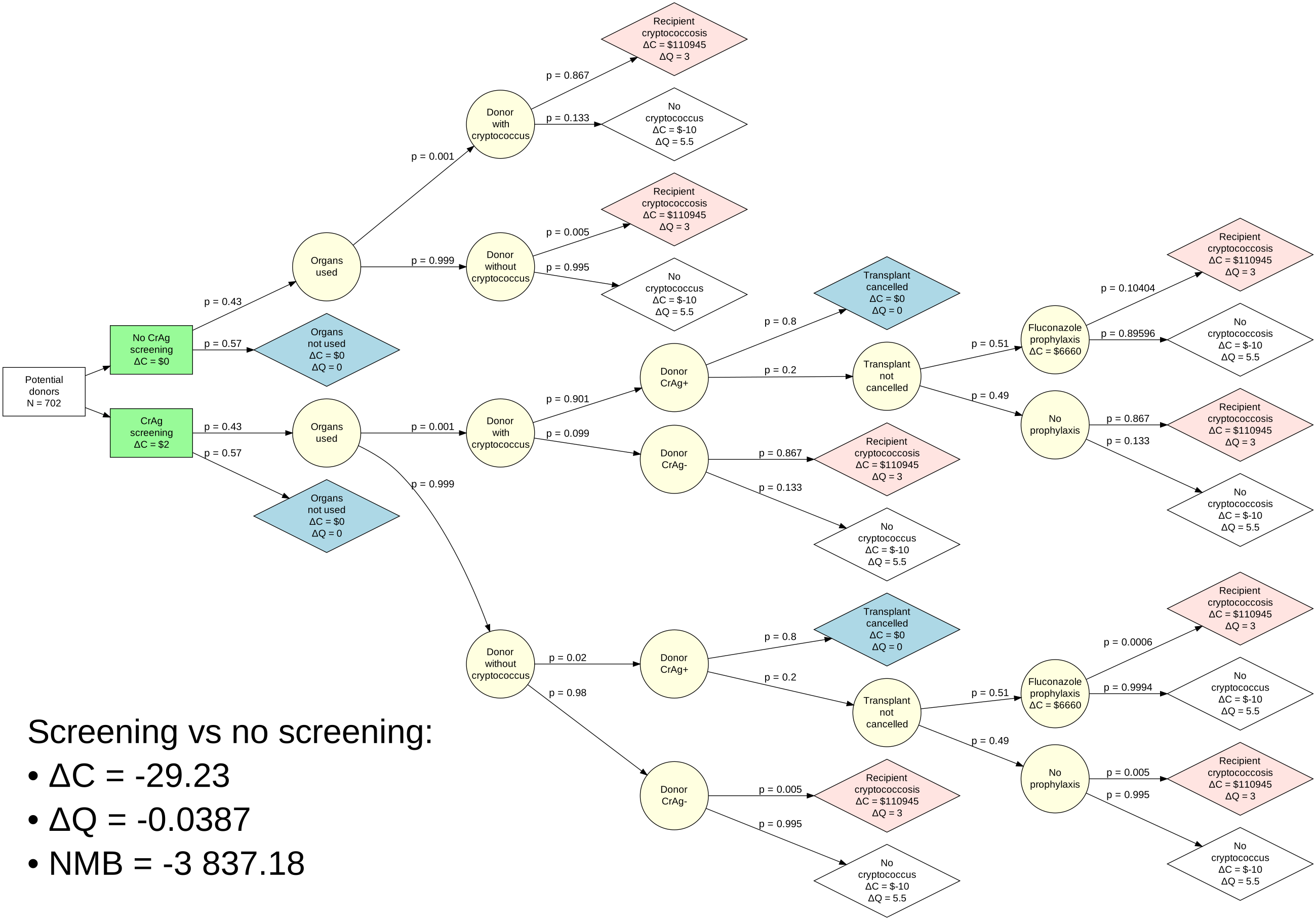
This project uses decision-analytic modeling to evaluate different strategies for managing cryptococcus risk in organ donors. In practical terms, the analysis asks:
If we adopt a particular donor screening or management strategy, what are the expected clinical outcomes and costs across many transplants?
Rather than focusing on individual cases, the model estimates average outcomes across a large hypothetical cohort of transplants, incorporating uncertainty in infection risk, test performance, treatment effectiveness, and costs.
Strategies evaluated
The analysis compares:
- no routine screening vs.
- donor screening with cryptococcal antigen testing, combined with recipient prophylaxis,
What “cost-effectiveness” means here
Cost-effectiveness analysis estimates:
- how much additional cost is associated with a strategy, and
- how much additional health benefit that strategy produces measured in quality-adjusted life years.
- how much additional health benefit it produces, compared to the baseline strategy, in Net Monetary Benefit. This parameter, in turn, depends on the willingness-to-pay, the amount of money a health system is willing to spend for a single QALY. Our analysis, like many, assumes a willingness to pay of $100,000 per QALY, yielding an equation for NMB:
\[ \text{NMB} = WTP \times \Delta Q - \Delta C \]
Results
- Base case analysis: primary results and interpretation
- Additional tree analyses: alternative clinical assumptions
- One-way sensitivity analysis: key drivers of results
- Probabilistic sensitivity analyses: uncertainty and robustness
- About: methods, assumptions, and disclosures
Reproducibility
All analyses presented on this website are fully reproducible.
The complete source code used to generate the decision trees, sensitivity analyses, and figures is publicly available at this GitHub repo. The R script R/main.R will run the R subscripts needed for this analysis in the order they are to be run. Model assumptions, parameter values, and analytic workflows are documented in the repository to facilitate transparency and reuse.
Abstracts/manuscripts
This analysis is based on a prior abstract presented at American Transplant Congress in 2019. It has yet to be published to date.