Scenario analyses
The code behind these results is on the Scenario trees page. Each scenario reruns the decision model with one or more inputs changed and every other input at its base-case value; Sensitivity analyses explained describes the approach. All numbers are per potential donor and are read from the output of the most recent model run.
The scenarios side by side
| Inputs changed | ΔC | ΔQ | NMB | Cost-effective at $100,000/QALY? | |
|---|---|---|---|---|---|
| Base case | none | −$29.23 | −0.0387 | −$3,837.18 | No |
| Scenario 1 | p_cancelled = 0.01 | $13.10 | −0.0001 | −$19.45 | No |
| Scenario 2 | p_cancelled = 0.01, p_prophrate = 0.99 | $23.93 | 0.0003 | $9.32 | Yes |
| Scenario 3 | cost_disease = 3000000 | −$1,003.11 | −0.0387 | −$2,863.30 | No |
| Scenario 4 | p_cancelled = 0.01, p_prophrate = 0.99, cost_disease = 3000000 | −$931.04 | 0.0003 | $964.30 | Yes |
What the comparison shows:
- Making cancellation rare (scenario 1) changes ΔQ from −0.0387 to −0.0001 QALYs per potential donor: lowering
p_cancelledfrom 0.8 to 0.01 removes 99.8% of the base-case QALY loss, which comes almost entirely from transplants cancelled after positive screens. Net monetary benefit is −$19.45. - Adding near-universal prophylaxis (scenario 2) gives ΔQ = 0.0003, a small net gain in health, with ΔC = $23.93 and net monetary benefit of $9.32 per potential donor, so screening is cost-effective, though only narrowly.
- A much higher cost of disease alone (scenario 3). Raising
cost_diseaseto $3,000,000 leaves ΔQ unchanged at −0.0387 and changes ΔC to −$1,003.11 per potential donor. Net monetary benefit is −$2,863.30, so even at this cost of disease, the money saved does not make up for the QALYs lost to cancellations. - All three changes together (scenario 4). Screening saves money and gains health, with net monetary benefit of $964.30.
The sections below show the annotated tree for each scenario.
Alternative case #1
Does the near-elimination of organ wastage (p_cancelled=0.01) affect the results of the base case?
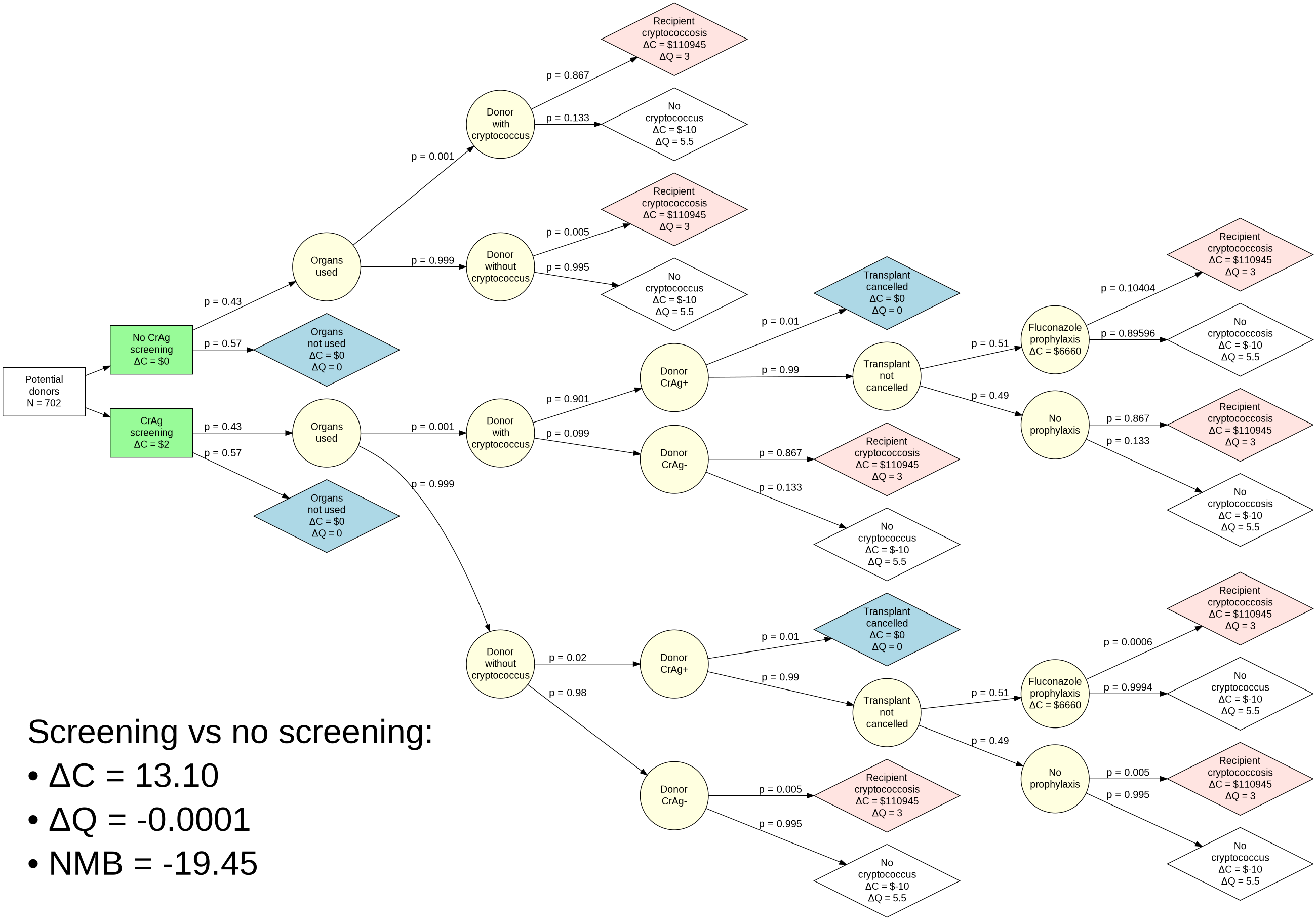 We see that this improves the NMB associated with screening but does not make screening the preferred strategy.
Alternative case #2
Does the near-elimination of organ wastage (p_cancelled=0.01) and near-universal prophylaxis (p_prophrate=0.99) affect the results of the base case?
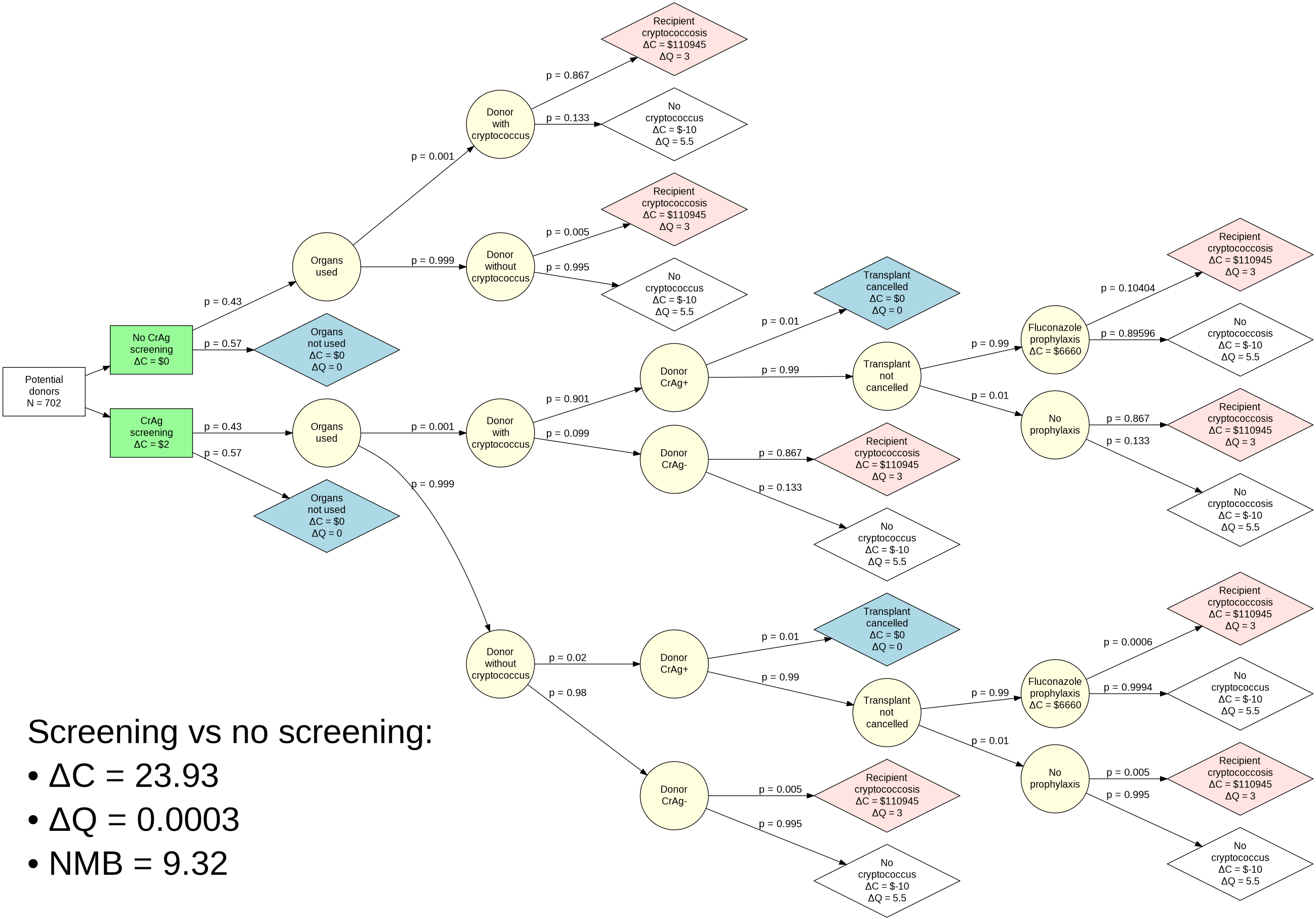
While screening is no longer cost-saving in this scenario, NMB is now expected to be positive, suggesting some benefit of screening. Most of the change in cost comes from cancelling fewer transplants (scenario 1 alone moves ΔC from −$29.23 to $13.10); near-universal fluconazole adds a further $10.84 per potential donor.
Alternative case #3
If the cost of cryptococcus is dramatically higher (cost_disease=3000000), does this affect our conclusions?
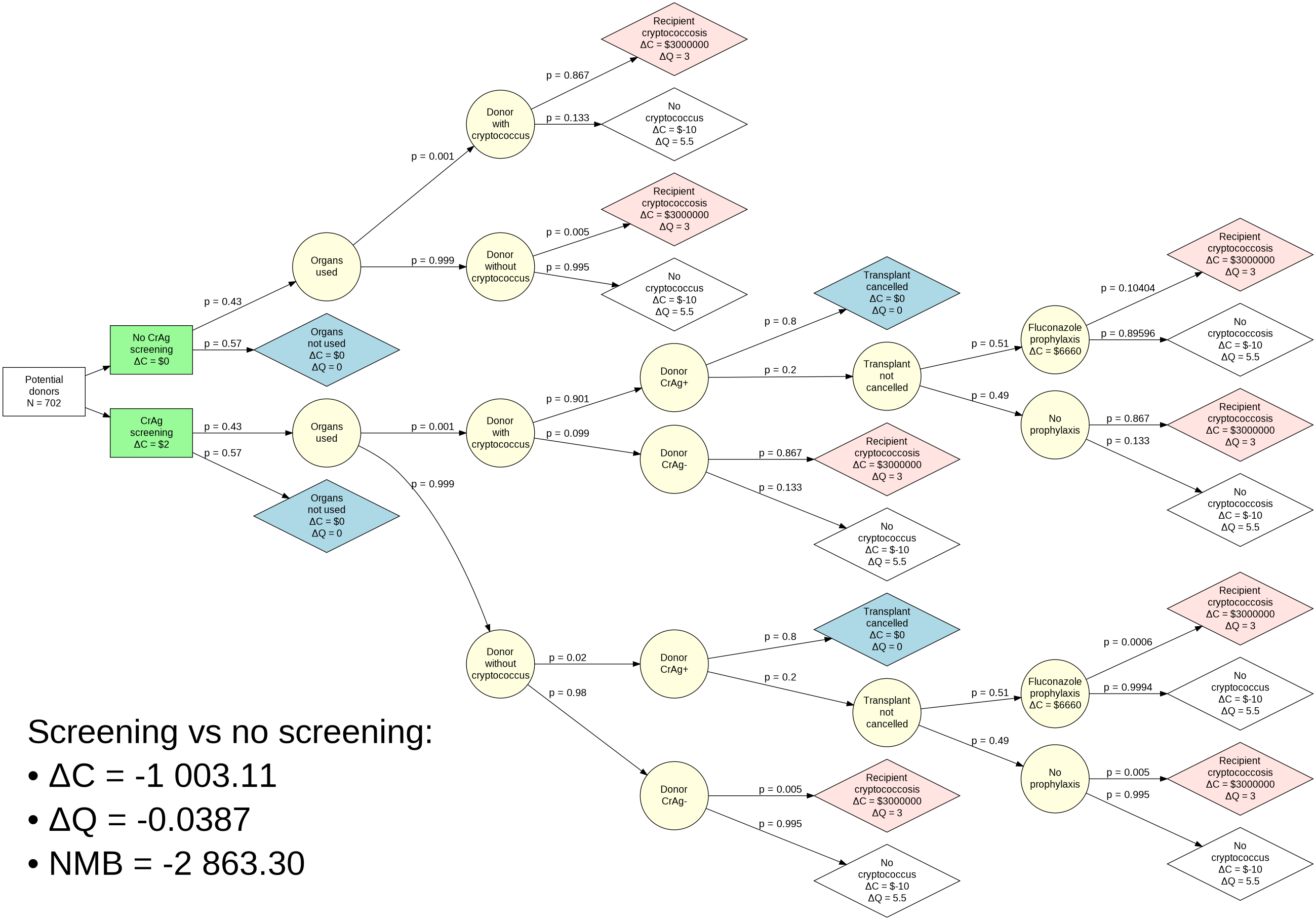
In this setting, the effects of organ wastage still appear to win out over the costs of disease.
Alternative case #4
IF we set the cost of cryptococcal disease markedly higher (cost_disease=3000000) while also assuming the near-elimination of organ wastage (p_cancelled=0.01) and near-universal prophylaxis (p_prophrate=0.99), what do we conclude?
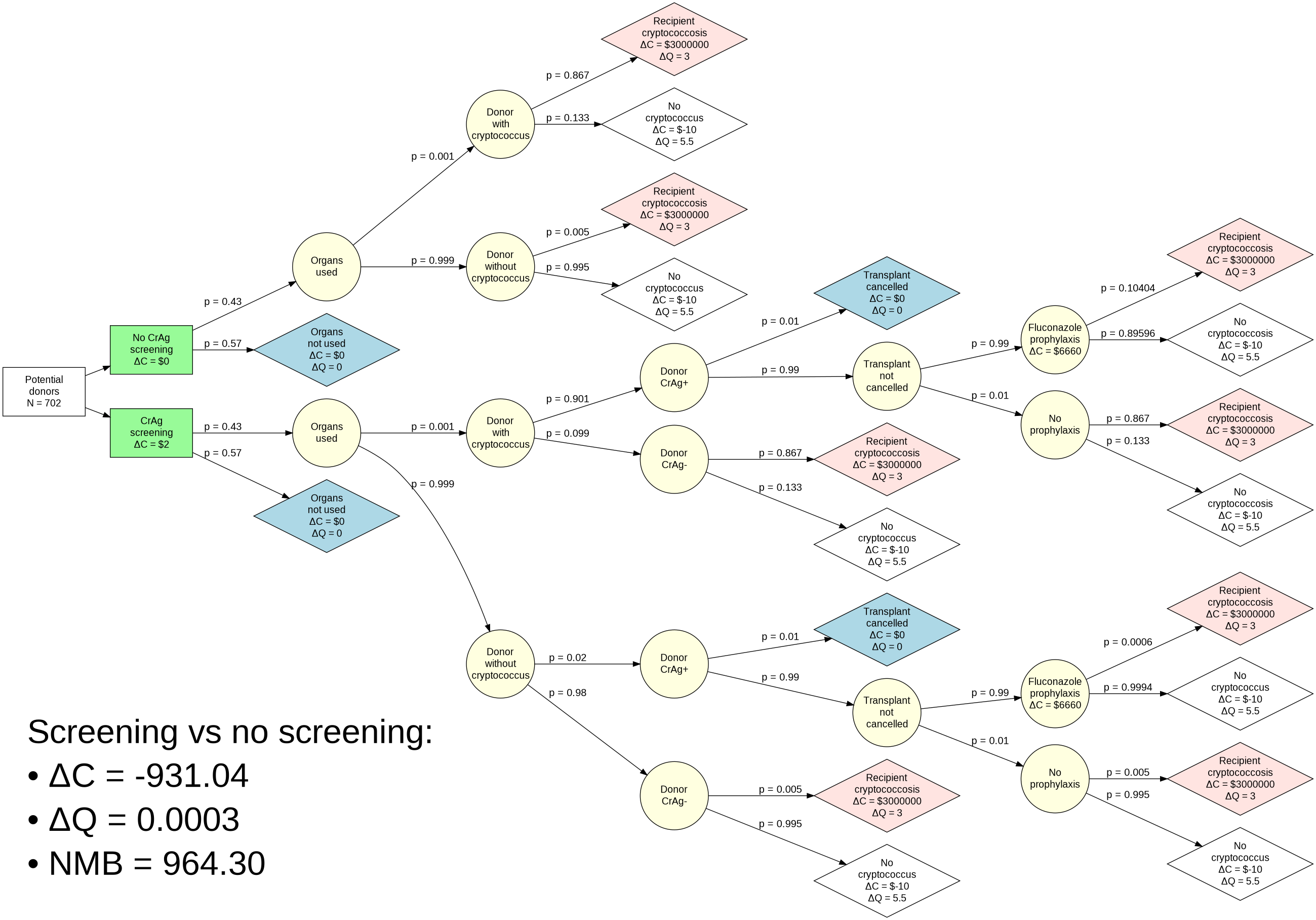
Screening is cost-effective under these circumstances (NMB $964.30 per potential donor), but its health gain is very small (ΔQ = 0.0003), and the result depends on the assumed $3,000,000 cost of each case of cryptococcosis.
Other results
- Base case analysis: primary results and interpretation
- One-way sensitivity analysis: key drivers of results
- Probabilistic sensitivity analyses: uncertainty and robustness
- About: methods, assumptions, and disclosures